woensdag 20 maart 2019

Dag 3 Dos Clerigos, Carmelitas e do Carmo - Casa de cha


We start our third day with a visit to the  Dos Clerigos tower and church


The church and the Tower are part of a baroque-inspired building from the 18th century, which marked the city's urban configuration, located on an uneven street, but brilliantly used by Nicolau Nasoni, who managed to create a landmark building. The Church and the Tower are adjoined to the House of the Brotherhood, which since 2014, after it became a museum, is open to the public


The donation of a land, located in Campo do Olival, at that time the largest plot of land in Porto, allowed the Brotherhood of the Clerics to build their own church.
The Church of the Clerics project, by Nicolau Nasoni, was approved at a meeting of the Brotherhood of the Clerics in December 1731. The works started in April 1732, with the opening of the foundations, thus beginning the construction of that which would become the first church in Portugal with an ellipse shaped plan. In addition,  the gallery that surrounds the entire nave, making it possible to observe the church as a whole, is also a unique feature of this temple. 


The dome boasts the coat of arms of the Brotherhood of the Clerics, in faux granite, and rests on six pillars, standing out two pulpits and two grids, the oldest examples of gold carving in the church, and four lateral altars are opened: the Blessed Sacrament, Our Lady of Sorrows, Saint Emygdius and Saint Anne. 


Our next visit is  to the surprising Carmo & Carmelitas’ Churches.
Carmo Church was built in the 18th century and is an amazing example of the baroque architecture. 
Outside, you will find a magnificent panel of blue and white tiles, representing the Brown Scapular imposition on Mount Carmel. The panel is rich in details, perspective and color and was designed by Silvestro Silvestri.


The Carmo and Carmelitas churches are two churches separated by one of the world’s narrowest houses. This house was built to make all contact between the nuns and the monks impossible. If you look closely, you’ll find Carmo Church (on the right) and Carmelitas Church (on the left).
Carmelitas Church was part of a convent in the 17h century. The building has a classical façade with a single a bell tower and a rich gilded interior. The church was used as barracks during the French Invasion of Porto (1808-1814).
On the Carmelitas’ church interior you’ll find a rich baroque and rococo style with gilded woodcarvings on the main altar and the lateral chapels. 


The Carmo church has also such  gilded woodcarving


We take a bus to the 
Jardim do Palácio de Cristal (Crystal Palace)the most beautiful gardens in Porto. 
 Not only the different gardens and spaces are a remarkable example of the gardens during the Romantic period, but they also are a terrific belvedere with views over the Douro river, Atlantic Ocean and the city itself.


We return to the CASA da Musica  to take the metro to the Mercado de Matosinhos from where we take a taxi to Restaurante Casa de Cha da Boa Nova, where Mieke has invited us to celebrate her birthday.


Boa Nova Tea House is much more than a restaurant. 
Those who visit it immediately perceive the immense horizon through the impressive windows, maximizing all the moment expectations.
Chef Rui Paula surprises customers with his audacity, taking them to the next level of gastronomic experiences, through a symbiotic vision where he really shows his innerself.


The singularity of the building that houses the restaurant remains a paradigm of architectural insertion in an exceptional landscape.


Result of the architectural genius Pritzker Siza Vieira, the property is one of the most emblematic works of the renowned architect. Born from rocks, and hand in hand with the sea,  designated as a National Monument and integrated in the International Architecture Itinerary.


Desserts


After a visit to the kitchen we take our coffee on he terrace.


A most fabulous food experience.  Thank you Mieke.


dinsdag 19 maart 2019

Day 2 Catedral. - Tram - Lello Library


We start our second day with a visit to the Catedral 'Sé" and the 
"Claustro" with the beautiful azulejos.


Portos Cathedral the Sé, is an historic landmark in the old centre, where the city was born. In fact, Morro da Sé is the oldest district in Porto. Its characteristic neighborhood and its residents are the most genuine part of the city.

The Cathedral itself is a 12th Romanesque structure. It was built by Bishop Hugh, a French nobleman who came to Porto even before Portugal’s independence, and ruled the city from 1113 to 1136.


Despite its Romanesque roots, you will see that the cathedral, all over the centuries, has been suffering many changes of different architectonical styles, like the baroque roofs of the turrets next the front door, or even the loggia outside the north wall of the building, designed by Nicolau Nasoni, in the 18th century.

The cloister walls of Porto's Cathedral are decorated with blue and white pictorial tiles some of which depict scenes from "The Metamorphosis" (Ovidius) and the life of Mother Mary. They are dramatic and grab your attention. 


You will find some of these tiles on the outside of the cathedral walls. This style of internal and external wall decoration can be seen around the world, wherever the old Portuguese Empire had an influence. What is the history of the Portuguese liking from blue and white "Azulejos" tiles? 


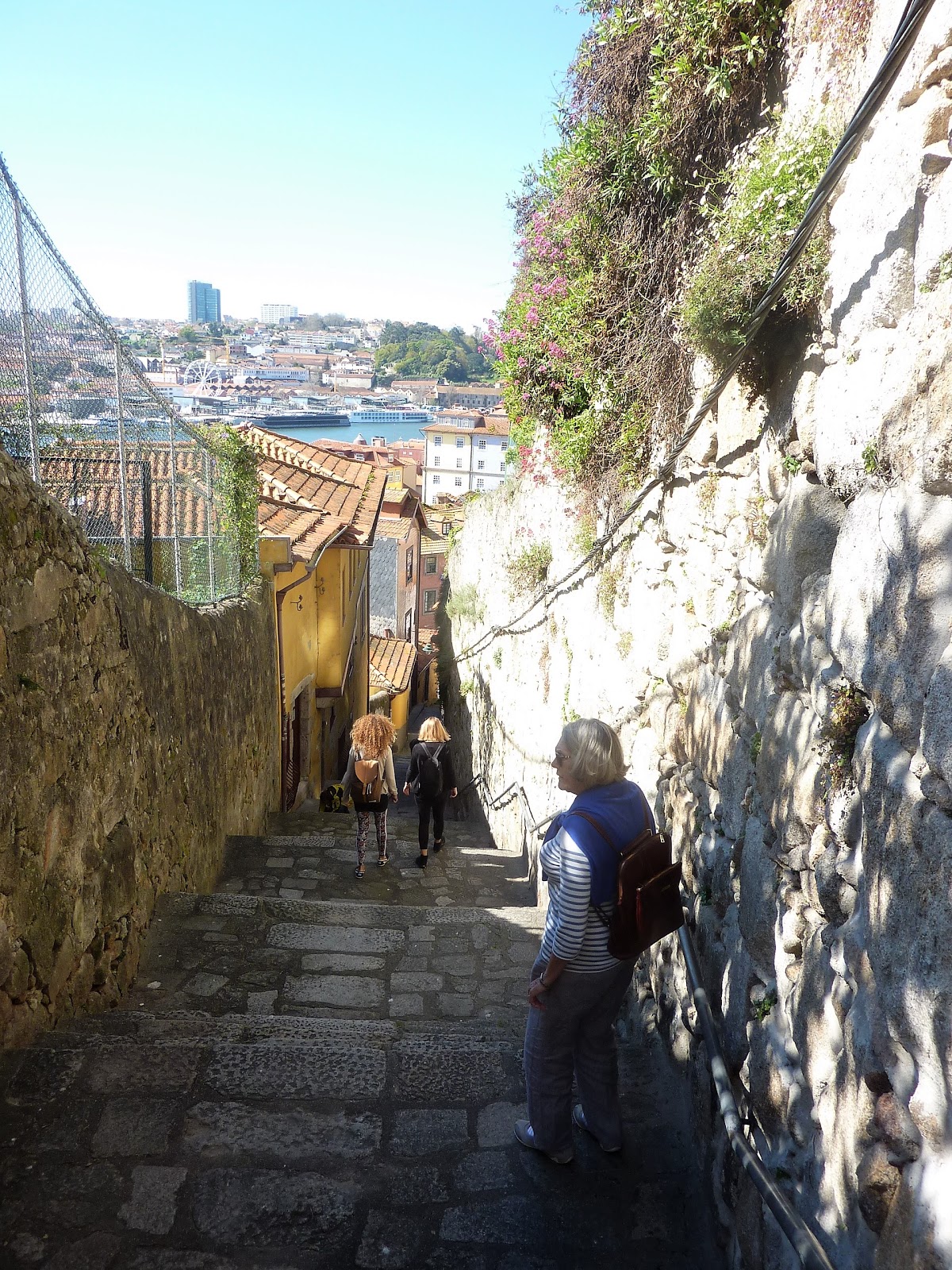
On our way down to the Douro we discover a very special chapel


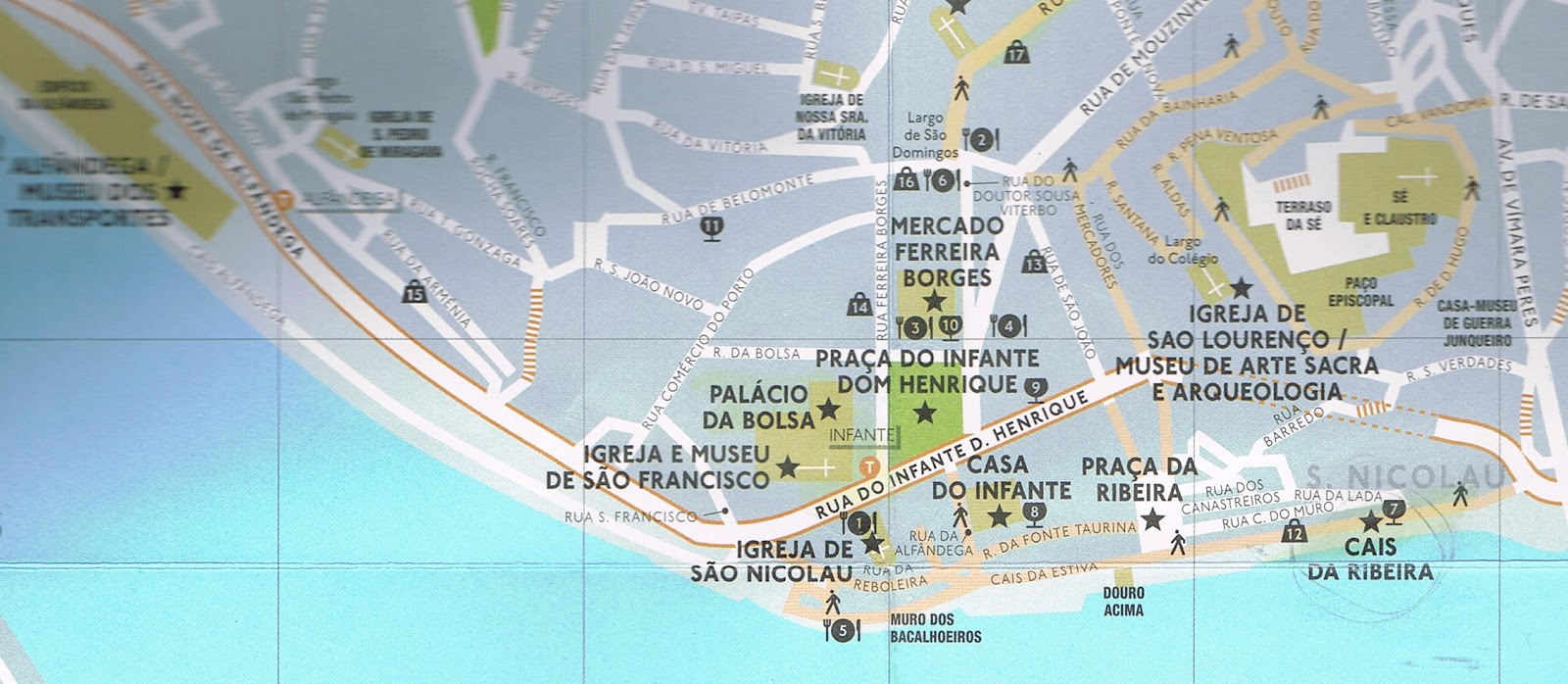
Praça da Ribeira


Igreja de Sao Nicolau


Palacio da Bolsa


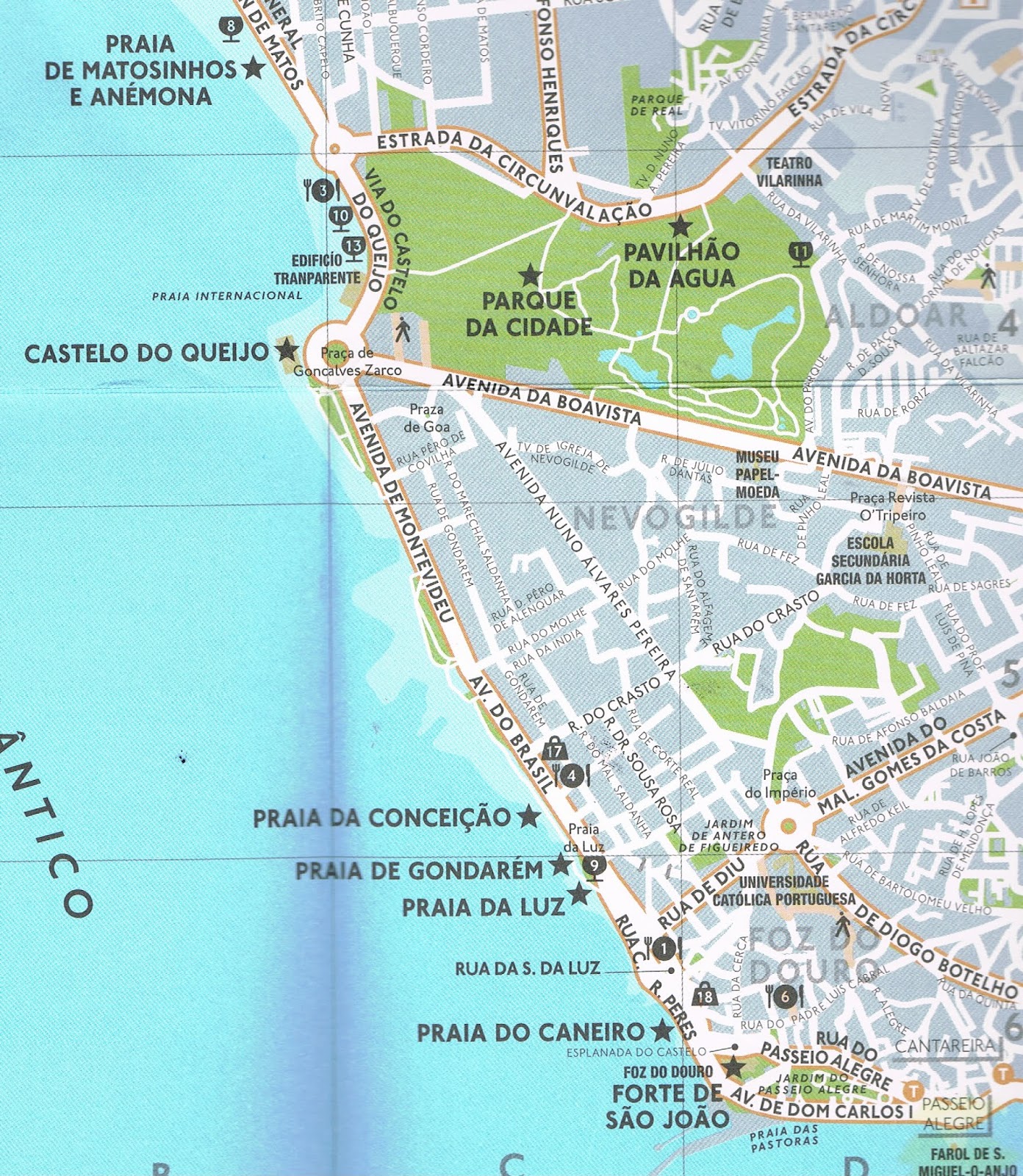
We take the tram along the Douro from the Infante station  to the terminus Passeio Alegre 


Farol de S. Miguel-O-Anjo 


We take Bus 500 to  Praça Goncalves Zarco and from there  
bus 205  along the Avenida da Boavista to the
Fundacao e Casa de Serralves 
(Museum of Modern Art) 

The Serralves Foundation’s mission is to raise the awareness and knowledge amongst audiences from different backgrounds and age groups, in relation to contemporary art, architecture and the landscape and key issues facing society at present and in the future. 
The Foundation has an integrated approach based on its exceptional heritage assets, including, in particular, the Museum of Contemporary Art and the Park.
Located in the city of Porto, the Foundation has a rich historical and cultural heritage, including the Museum, designed by the architect Álvaro Siza, winner of the 1992 Pritzker Prize, the Serralves Villa, a unique example of art deco architecture, and the Serralves Park, designed by the French architect Jacques Greber, which was awarded the "Henry Ford Prize for the Preservation of the Environment” in 1997. 
In 2012, Serralves’ Park and buildings were jointly classified as a "National Monument”. This is the most important heritage classification level, and was granted in recognition of Serralves’ cultural, architectural and landscape value and the investment in the enhancement, animation and dissemination of the Foundation’s heritage assets.


 We then take bus 201 to  the Casa da Musica at the Praça Mouzinho de Albuquerque


Livraria Lello is a living access door to its history: for preserving the building, for maintaining its original function as a bookshop, for the role of ambassadress of culture and for expanding the cultural dynamics of the city.

For more than a century, Livraria Lello has been a main showcase for Portuguese literature, both nationally and internationally, helping export Portuguese literature to the rest of the world.

In the last decade, Livraria Lello has been officially recognized as “one of the most beautiful bookshops in the world” by the magazine Time, The Guardian, and the travel guide Lonely Planet.


On our way home we pass the Torre dos Clerigos, which we will visit tomorrow.


 In the evening we go for dinner to Guarany
on the Avenida dos Aliades